


苍天有泪
苹果首席执行官库克微博“推广”homepod智能演讲者,有声有色_我的网站

一 |
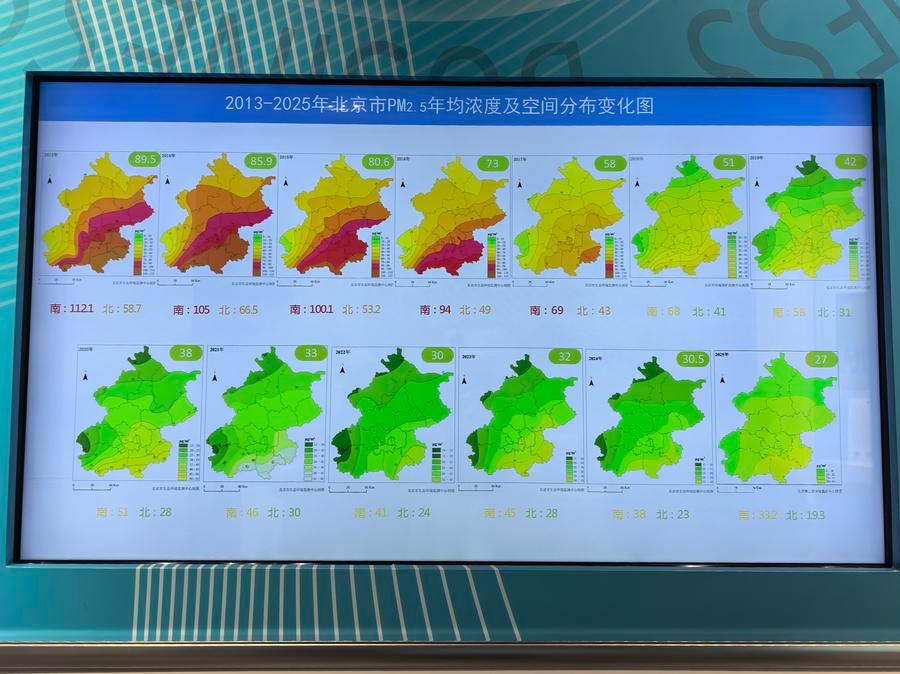
In 2025, Beijing recorded 311 days with good air quality and only one heavily polluted day, compared with 58 heavily polluted days in 2013, when the city officially began releasing PM2.5 monitoring data. The annual average PM2.5 concentration, a key indicator of air quality, fell from 89.5 micrograms per cubic meter in 2013 to 27 micrograms per cubic meter in 2025, a decline of nearly 70 percent.
The progress has drawn international attention. The United Nations Environment Programme has highlighted Beijing's experience in improving air quality as a model for other cities.
According to experts at the Beijing Municipal Ecological and Environmental Monitoring Center, the cleaner air is the result of a comprehensive system integrating environmental monitoring, scientific analysis, policymaking, regional cooperation and law enforcement -- with digital technologies now woven into every link of that chain.
MORE TARGETED APPROACH
Effective governance begins with accurate monitoring. Beijing has established a multi-level air-quality monitoring network. Figures show 35 standard monitoring stations across the city continuously measure six major pollutants, while more than 1,000 compact sensors deployed across communities and townships provide more detailed information on local air-quality variations.
The monitoring system was gradually built by the Beijing Municipal Ecological and Environmental Monitoring Center, one of China's earliest ecological and environmental monitoring institutions, responsible for monitoring Beijing's air, water, noise, soil environments and ecosystems.
The center has developed an analytical system that can identify around 125 components of PM2.5, covering most of its composition and helping researchers trace pollution sources.
"Source analysis helps us identify the major contributors to pollution at different stages, providing a scientific basis for policymakers to target key emission sources," said Li Yunting, technical director at the center.
Coordinated by the Beijing Municipal Ecology and Environment Bureau, the center has conducted four rounds of PM2.5 source analysis studies with other institutions, with results released in 2014, 2018, 2021 and 2025.
The latest analysis showed that regional transport contributed 57 percent of Beijing's PM2.5 pollution. Among local sources that accounted for the remaining 43 percent, vehicle emissions and residential sources represented the largest share of pollution, a distinctive characteristic of a major international metropolis.
The monitoring results have provided scientific support for a series of pollution-control measures. For example, Beijing has promoted new-energy vehicles to reduce transport emissions and adopted advanced techniques, including air-supported membrane structures, to control dust emissions. Meanwhile, coal combustion pollution, once a major contributor, has almost been eliminated and is no longer listed among the main sources, reflecting broader national efforts to reduce coal consumption, promote clean energy and upgrade heavily polluting industries.
With PM2.5 concentrations now at relatively low levels, further gains in air quality will depend on more targeted, science-driven approaches.
SMARTER ENVIRONMENTAL GOVERNANCE
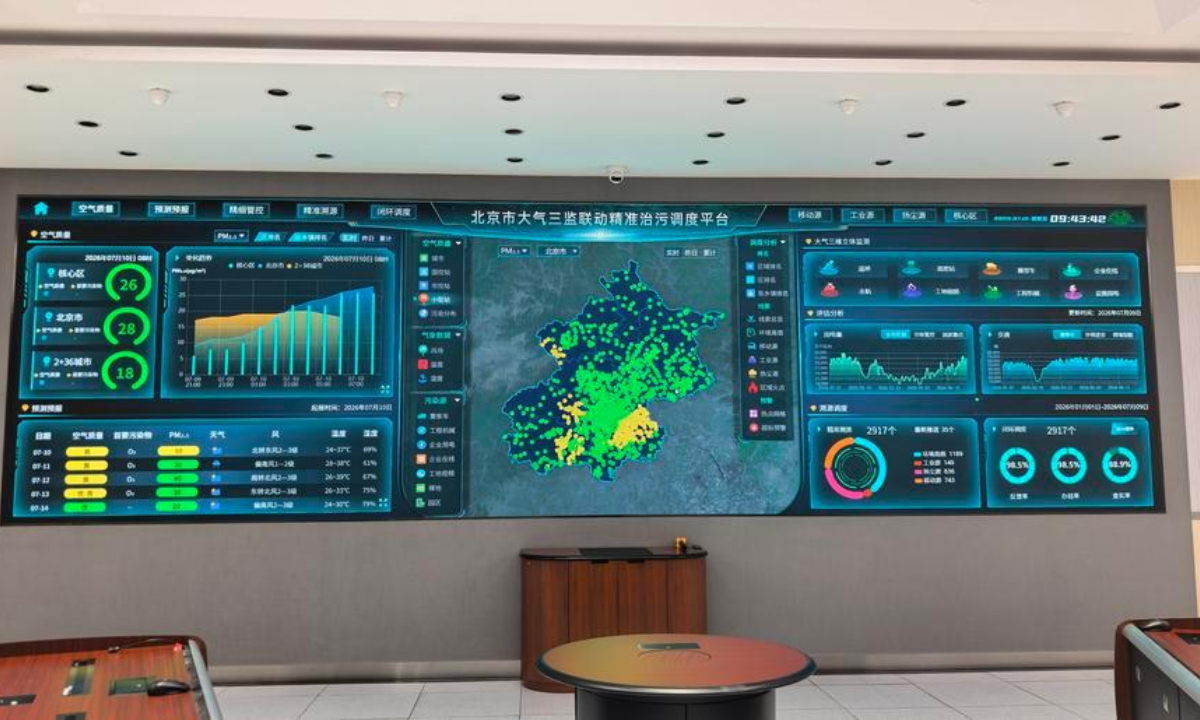
Beyond monitoring pollution, Beijing has built a data-driven environmental governance system that links monitoring, regulation and enforcement in a closed loop from detection to action and follow-up evaluation.
Developed by the center and known as the innovative regulation-monitoring-inspection linkage model, the system integrates artificial intelligence, the Internet of Things, satellite remote sensing and vehicle-mounted monitoring technologies to pull together environmental data from multiple sources onto a unified platform.
"The system brings information that was once scattered across different departments onto a single platform," said Zhang Likun, director of the smart system division at the center, adding that this enables off-site enforcement and joint cross-sector actions involving housing, water resources and transportation, significantly improving the efficiency and precision of environmental management.
Using more than 30 intelligent algorithms, the platform automatically analyzes data and identifies potential pollution risks, based on which monitoring staff identify the most pressing problems and forward them to enforcement departments.
The approach has already drawn international attention. Clean Air Asia, an international nongovernmental organization focused on improving air quality across Asia, featured the system as a representative case study in its "China Air 2025" report. The model was also presented at the 2026 Better Air Quality Conference and recognized with the Certificate for Clean Air Best Practice Sharing.
China has integrated ecological conservation into its modernization drive. As the country speeds up efforts under the Beautiful China Initiative, Beijing's experience demonstrates how technology can support more precise, coordinated and sustainable environmental governance.
。

二 | 1月14日新闻:今天是许多水果爱好者的又一个激动人心的日子,因为苹果已经发布了智能扬声器homepod一年半,并最终来到了国内市场。

三 | 据了解,苹果HooPod智能扬声器将在中国的内陆和香港销售在星期五,1月18日,提供白色和空间灰颜色匹配。国民银行的价格是2799元。苹果首席执行官库克几年前推出了微博,目前有109万粉丝。但在工作日,库克很少在微博上与粉丝互动,这通常是苹果新产品发布的“大事件”,库克只发送一两个微博。

四 | 今天,库克经常在他的微博上“推销”homepod,而文中说,他迫不及待地想让中国消费者听他们最喜欢的音乐,享受他们在homepod上美妙的声音。然而,评论区的网友在微博上分享了一张“大脑大开口”的假照片。你可以感觉到,在今年年初,有消息称,由于销售不佳,苹果已经减少了对iPhoneXR的订单。与此同时,iPhone XR和iPhone 8系列等手机在中国已经开始大幅降价,以北京东方平台的iPhone 8和iPhone 8 Plus为品牌。例如,它的价格降到了3999元和4799元,分别下降了600元和800元。去年秋天发布的iphone xs/xs max/xr等手机也在全国范围内降价,其中iphone xr频道的降价幅度最大,为450元至5250元。许多分析人士认为,苹果降价是为了刺激中国市场,但考虑到国内高端手机市场已不再由苹果主宰,降价是否能逆转iPhone的国内销售尚不清楚。苹果京东第二场秀,iPhone XR 5399 12免息:之前。
Current article:http://vb8kf.jiubengtaibingpengou.pics/we5myp3/20260826/628.html
Published on:19:39:51